
The observations that make slab foundation repair worth investigating, and the ones that do not.
Start with the principle
An observation is not a diagnosis.
What you can see — a crack, a gap, a door that catches — is a fact. What it means is a conclusion that requires measurement and context. Everything below is a list of observations worth taking seriously, and none of them establishes on its own that your slab needs repair.
That distinction matters commercially. A pier count produced from a look at a crack is a commercial estimate, not an assessment, and it is usually generous in the estimator’s favor.
The observations that matter on a slab home
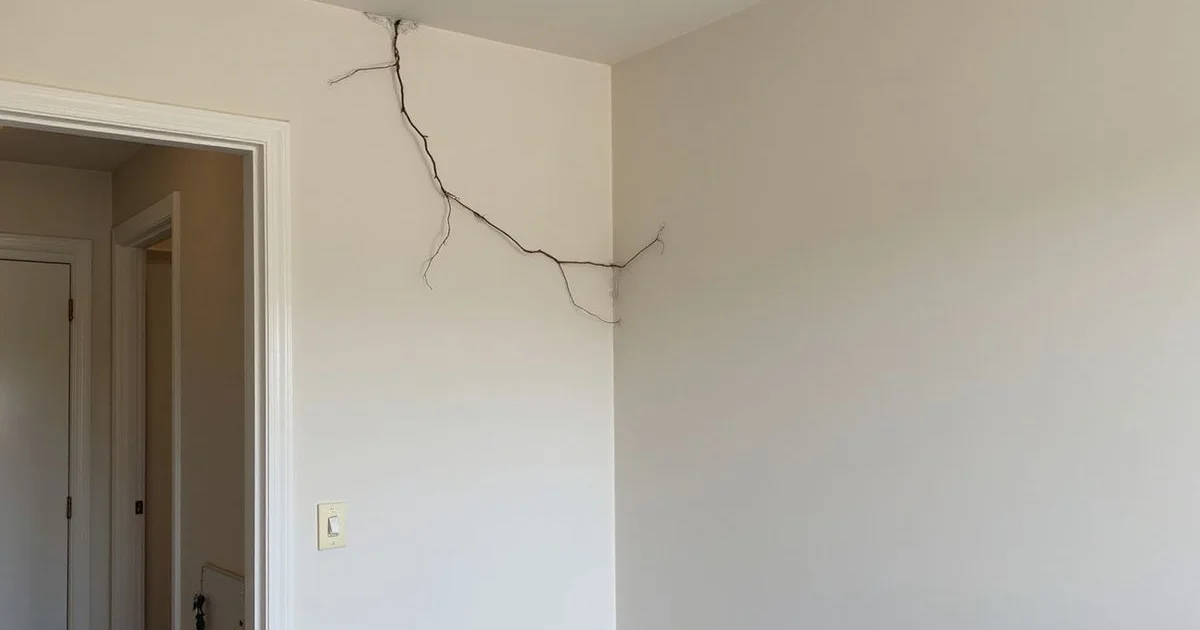
Cracks in interior walls
Diagonal cracks running from the upper corners of door and window openings are the pattern worth noting, because openings concentrate stress. Cracks at the junction of wall and ceiling, and cracks that reopen in the same place after being patched, are also informative — a reopened patch tells you something moved after the patch went in.
Hairline cracking scattered through a house with no pattern is usually finishes behaving normally.
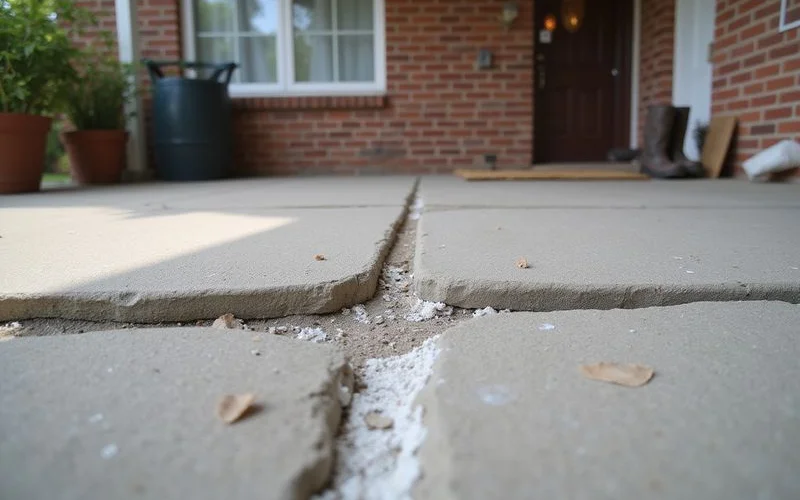
Exterior masonry
Stair-step cracking following the mortar joints in brick veneer, typically radiating from a window or door opening or appearing near a corner. Worth photographing and worth watching.
Also worth noting: whether the crack is wider at the top or the bottom, and whether anything inside the house lines up with it.
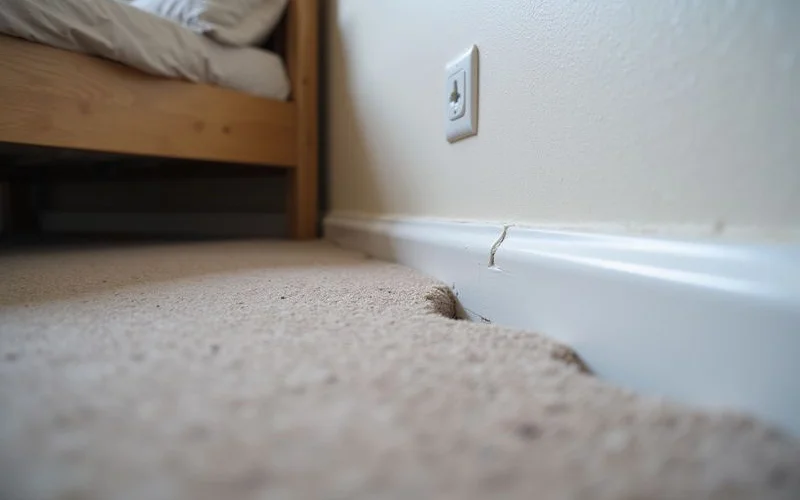
Separations
Gaps opening between baseboard or trim and the wall. Gaps where a porch, step, or addition meets the main structure. Separation between brick veneer and a window frame.
These matter because they indicate two parts of a structure moving relative to each other, which is more specific information than a crack in a single surface.
Doors and windows
Doors that bind, latches that no longer line up, windows that have become hard to operate. Walk the house and operate every door rather than relying on the one you noticed.
The pattern across the house is what carries information. One sticky door in a hallway is probably just a door.
Floors
A room that feels like it falls toward one side. Tile cracked in a line rather than in one spot. A hardwood floor that has developed a noticeable slope near one wall.
Some slope exists in nearly every house including new construction. Magnitude, distribution, and change are the questions.
Outside at ground level
Soil pulled back from the slab edge in a dry spell. Water pooling against the foundation after rain. A downspout discharging right at the wall. A large tree very close to the perimeter, or one that has recently been removed.
What appearance alone cannot establish
| The question | Why a photo cannot answer it |
|---|---|
| How much has the slab moved? | Requires relative elevation readings across the house |
| Which direction — settlement or heave? | Requires the elevation pattern, not the crack |
| Is it still moving? | Requires two dated observations, not one |
| What caused it? | Requires drainage, plumbing, tree, and construction context |
| How many supports would it need? | Requires the survey and the load path |
Anyone answering those from an image is guessing.
What to do before calling anyone
Document it. Dated photographs, wide and close, with scale. Pencil marks at crack ends with the date beside them. A note of which doors are affected.
Check the cheap causes. Downspout discharging at the foundation? Irrigation zone soaking one corner? Gutter blocked? Grade falling toward the house? Some of these you can fix in an afternoon, and one of them may be the entire explanation.
Wait and re-photograph. Four to six weeks later. Change is the single most useful piece of evidence there is, and it costs nothing to collect.
When to get it measured
If observations are changing, if several line up on one side of the house, if something has stopped working, or if you need documentation for a sale — that is when a foundation evaluation earns its cost, because the elevation survey turns observations into evidence.
If the evidence supports work, slab foundation repair explains what that involves, and what to expect during a slab foundation repair project walks through the sequence on site. If it does not, a good evaluation says so and you keep the report either way.