
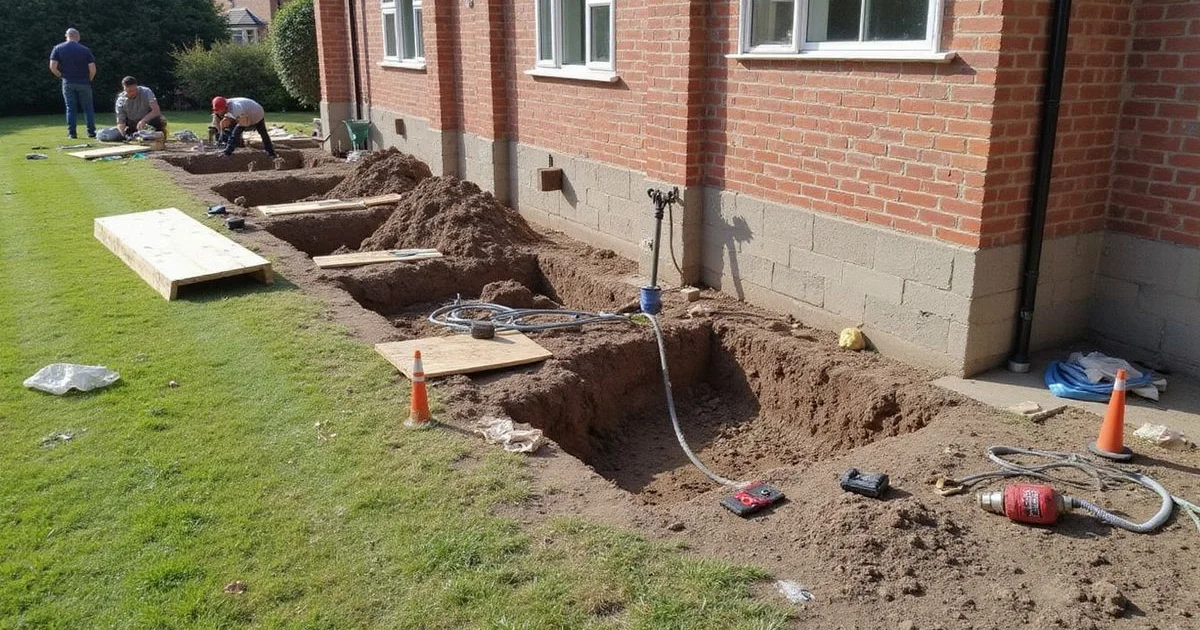
Why almost every case turns out to be targeted slab foundation repair rather than a new foundation.
The short version
Most Fort Worth homeowners who arrive at this question have been worrying about something that turns out to be a targeted repair.
Foundation movement in residential slab homes is normally addressed by installing supports at the locations where the elevation survey shows support is needed — commonly a section of the perimeter — and stabilizing or lifting from there. Full foundation replacement is rare, and for good reason: it means dealing with the entire house sitting on top of the thing being replaced.
If you are reading this because someone used the word “replacement”, the most useful thing you can do is ask what measurement led them there.
What underpinning actually addresses
Underpinning does not repair the concrete. It changes what the concrete is resting on.
Supports are driven down to material capable of carrying load, brackets transfer some of the building’s weight onto them, and the foundation is stabilized or raised from that new reference. The slab itself, cracks and all, remains the slab.
That works because in most cases the slab is not the problem. The ground beneath part of it moved, and the slab followed. Give it stable support and the movement stops; recover elevation where that is appropriate and the geometry improves.
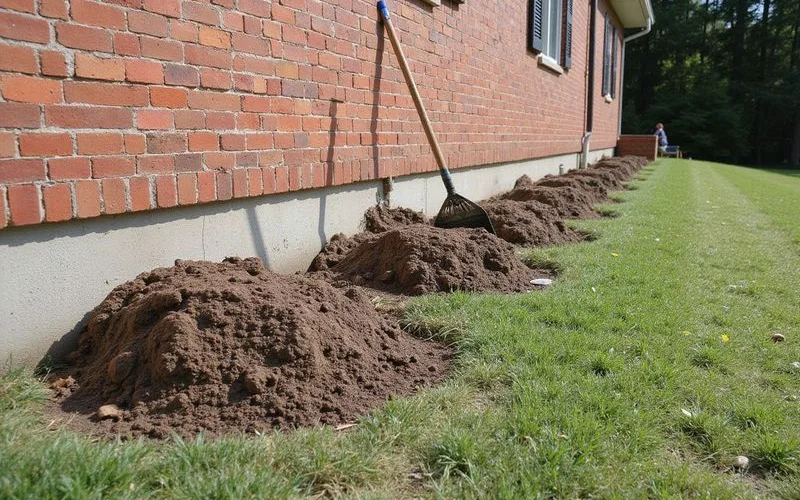
What replacement means, practically
Replacing a slab foundation means removing it and building a new one, with the house either supported above or removed.
The sequence, in outline: the structure is shored and lifted, or demolished; the existing slab is broken out and cleared; the subgrade is prepared, which may involve removing and replacing unsuitable material; a new foundation is designed and poured; the structure is set back down and reconnected.
Every service entering the house is affected. Every finish connected to the floor is affected. The household cannot live there during it.
The economics of that rarely favor replacement over either repair or demolition and rebuild. Which is why, in residential work, it is uncommon rather than routine.
What the two paths compare like
| Targeted repair (underpinning) | Full replacement | |
|---|---|---|
| What it changes | What the foundation rests on | The foundation itself |
| Typical duration | Days | Months |
| Occupancy | Usually stays occupied | Not habitable |
| Services | Largely undisturbed | All affected |
| Interior finishes | Mostly undisturbed | Substantially affected |
| Cost scale | Repair scale | Construction scale |
| Frequency in residential work | Common | Rare |
The cost factors guide covers what moves the number within the repair column, which is where nearly every real project sits.
When replacement genuinely comes up
It is worth saying that it is not never. Situations where it enters the conversation:
- The concrete itself has deteriorated structurally rather than the ground beneath it having moved
- Original construction was fundamentally inadequate for the loads or the site
- A separate element — a poorly built addition or extension slab — has failed on its own terms and is better removed than repaired
- Rebuilding is happening anyway for other reasons, and the foundation is being replaced as part of that
Notice that only one of those is really a foundation-movement scenario. The rest are construction decisions that happen to involve the foundation.
The question to ask
“What in the elevation survey and the site evidence distinguishes this from a case you would address with underpinning?” A recommendation for replacement should have a specific, measurable answer to that.
How to approach the decision
Start with measurement. A foundation evaluation produces the elevation picture, documents the observations, and considers the site conditions. That is the evidence base for any scope.
If a repair scope comes back, read it against the comparison worksheet and satisfy yourself the quantities are supported.
If replacement comes back, get an independent opinion from a licensed Professional Engineer before doing anything else. Not because the recommendation is necessarily wrong, but because the scale of the decision warrants an assessment from someone who is not selling the work.
And if you are here because a website made replacement sound like a live possibility for a house with a crack over the front door — it very probably is not. See signs your slab foundation needs repair for what those observations actually indicate.