

Why there is no honest average price
The first thing to say about foundation repair cost in Fort Worth is that anyone publishing a single citywide average is giving you a number that describes no actual house.
The variables are too large. A slab home needing eight exterior supports in accessible soil, with shallow refusal depth and minimal restoration, is a fundamentally different project from a pier-and-beam home needing crawlspace re-support, joist repair, and a moisture problem addressed first. Averaging them produces a figure that is wrong for both.
What is genuinely useful is understanding the factors that move the number, because those let you read a proposal rather than just react to its total.

The factors that actually drive cost
Foundation type. Slab-on-grade and pier-and-beam involve different work entirely. A slab job typically means exterior excavation and underpinning along the grade beam. A pier-and-beam job means working from the crawlspace, re-supporting piers and possibly repairing framing. Post-tensioned slabs add an extra consideration wherever cutting or coring is involved, because tendons have to be located first. Read more on slab foundation repair.
Method. Driven steel piers generally cost more per location than pressed concrete piling, and reach deeper. Where competent bearing material is shallow and consistent, concrete may be entirely appropriate at lower cost. Where depth is uncertain or known to be significant, steel is usually the right answer. The method is a legitimate reason for two quotes to differ.
Quantity. How many supports the evidence indicates. This should come from the elevation survey and the load path, not from the square footage of the house. Pier counts are the single most common source of large discrepancies between proposals, and the question to ask is always: what measurement supports this number?
Depth actually reached. Driving to refusal means going until the resistance indicates competent material. That depth varies by property and sometimes across one property. A proposal is a prediction; what happens during installation is the reality, and the contract should be clear about how that is handled if depths run deeper than anticipated.
Access. Landscaping, hardscape, fences, slopes, tight side yards, and equipment reach all affect how long each location takes and how much work is needed either side of the actual installation. A perimeter with mature planting and a stamped concrete patio is not the same job as an open lawn.
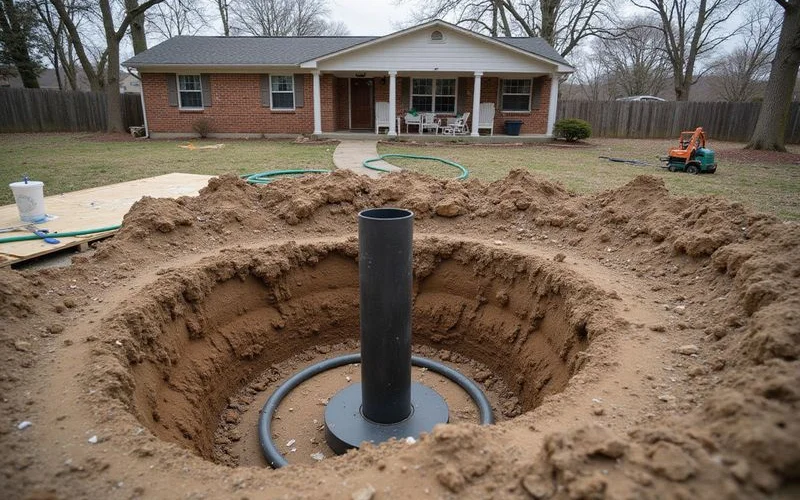
Excavation. Volume of soil moved, where it goes, and how it is reinstated. Interior work — opening flooring and cutting the slab — is substantially more disruptive and more expensive than exterior work, and should be itemized separately.
Engineering. Whether an assessment or a stamped plan is required, and who pays for it. Some scopes and some jurisdictions require it; some transactions call for it independently of the repair.
Permits. Fees and inspection requirements vary by jurisdiction, and the Fort Worth process is not the same as Arlington’s or Keller’s. The proposal should state who pulls the permit.
Associated work. Hydrostatic plumbing testing where a leak is suspected. Drainage correction where water is concentrating against the foundation. Void grouting after a lift. These are separate scopes that often belong with the repair but should be priced separately.
Restoration. Backfill and rough grade are almost always included. Turf replacement, replanting, concrete flatwork, interior cosmetic repair, and masonry repointing frequently are not. This is where a low-looking quote and a higher one often turn out to be closer than they appeared.
How to read a scope
A proposal you can compare has these elements written down, and one you cannot compare is missing several of them:
| Element | What to look for |
|---|---|
| Method | Named system, not “piers” |
| Quantity | Number and locations, with the survey that supports them |
| Depth basis | Driven to refusal, with how variance is handled |
| Inclusions | Every operation covered by the price |
| Exclusions | Written explicitly, not implied by omission |
| Permits | Who applies, who pays |
| Schedule | Expected duration and what extends it |
| Warranty | Duration, triggers, exclusions, transferability |
| Payment | Deposit, stages, final |
The single most useful question
“What is not included in this price?” A provider who answers it clearly and in writing is giving you something you can compare. A provider who waves it away is leaving room to add later.
Why the cheapest quote deserves the same scrutiny as the most expensive
A low proposal is not automatically a bad one. Sometimes a company has looked at the evidence and concluded the house needs less work than a competitor proposed, and that is worth paying attention to rather than dismissing.
What makes a low number a concern is when it is low because something has been left out that will have to happen anyway: restoration, permits, plumbing testing, or the depth the site actually requires. Those reappear as change orders, and the final figure is no longer the one you compared.
The mirror image applies to the highest quote. A large number is not evidence of thoroughness. A pier count that nobody can justify against a survey is a pier count that was decided commercially.
Our guide to comparing two foundation repair quotes sets out a worksheet for doing this properly, and the warranty guide covers the part of the document most people skim.
Where cost stops being the question
If the elevation evidence does not support structural work, the cheapest option is the correct one: monitoring, drainage correction, and a repeat survey in twelve months. That recommendation costs you an evaluation and nothing else, and it is a legitimate outcome that a good provider should be willing to reach.
Getting to that answer requires someone to measure the house rather than quote from a photograph. That is what an evaluation is for, and it is the step that turns a price question into a scope question.