
Previous repair is information, not a verdict
A house with documented foundation repair is not automatically a worse buy than one without. In some ways it is a better-understood one: a known issue that was assessed, scoped, carried out, and recorded.
What makes a repaired home difficult to evaluate is the absence of records. Evidence of work with no scope, no invoice, no installation record, and no warranty leaves a buyer guessing about what was done, how deep it went, and whether anyone stands behind it.
This guide is about the documents that close that gap, and what to do when they do not exist.

The documents to request
| Document | What it tells you | Why it matters |
|---|---|---|
| Original evaluation or engineering report | What condition prompted the work | Establishes the problem that was being solved |
| Written scope | What was proposed and agreed | Defines what the price actually covered |
| Invoice | What was paid for and when | Confirms the scope was completed |
| Installation records | Locations, depths, pressures | Shows what was actually reached on site |
| Post-repair elevation documentation | The floor plane after the work | The baseline for judging later movement |
| Permit records | Whether the work was permitted and inspected | Third-party record that it happened |
| Warranty document | Coverage, triggers, exclusions, transferability | Whether anyone still stands behind it |
Post-repair elevation documentation is the one people most often do not think to ask for, and it is arguably the most useful. Without it, nobody can say whether the current floor plane represents the outcome of the repair or movement that has happened since.
Confirming the warranty before closing
This is a time-sensitive item and it is worth handling early rather than in the final week.
Read the full warranty document rather than the summary. Establish whether it transfers, what conditions apply, whether there is a fee, and — critically — whether there is a window after closing within which the new owner must register. Then contact the issuing company directly to confirm the warranty is live on that property and that the transfer will be honoured.
A warranty that lapsed because the transfer paperwork was never filed is a piece of paper. The warranty guide covers what these documents typically contain and where they typically fall short.
What to look for at the property
Even with a good document set, walk the house with the records in hand.
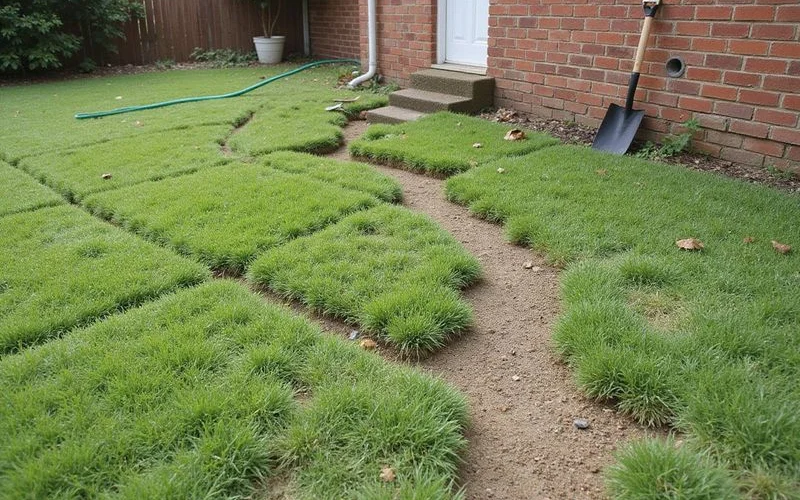
Outside. Look for the physical evidence of previous work: patched sections of turf or flatwork along the perimeter, disturbed planting in a regular pattern, mortar repointing along a section of brick. Compare where you see evidence against where the installation record says supports went. A mismatch is a question.
Inside. Look for cracking that has appeared or reopened since the repair date, doors that bind, and floor slope. Some settling of finishes after a lift is normal; new structural-pattern cracking several years later is a different matter.
On a pier-and-beam home, get under the house if you can, or have someone do it. Look for whether the support work is properly built — new piers on adequate pads, shims correctly seated — or improvised. Bottle jacks left in place, stacked timber packing, and ad hoc shimming indicate informal work rather than a scoped repair, whatever the paperwork says.
Any home, check whether drainage obligations the warranty imposes have been met. A warranty with owner maintenance requirements that were ignored may already be compromised.
If there are no records at all
This happens often, particularly on older homes that changed hands several times.
The practical response is to commission your own assessment and treat the property as unknown rather than either repaired or unrepaired. Where the outcome will affect price negotiation, disclosure, or financing, a licensed Professional Engineer’s independent assessment is usually the right document, because it does not come from a company selling the repair. Our guide to assessment documents covers which document suits which situation.
A current foundation evaluation establishes the present floor plane and observations, which at minimum gives you a dated baseline going forward even if the history stays unknown.
If you are the seller
Assemble the file before listing. Scope, invoice, installation records, elevation documentation, permit records, and the warranty with its transfer terms.
Then contact the warranty issuer and find out exactly what a transfer requires, so it can be handled during the transaction rather than discovered at closing. A complete, verifiable record turns “this house has had foundation work” from a concern into a documented fact, which is a substantially easier thing to sell.
The principle on both sides
Repair with records is a known quantity. Repair without records is an open question, and open questions get priced conservatively by whoever is on the other side of the table.