
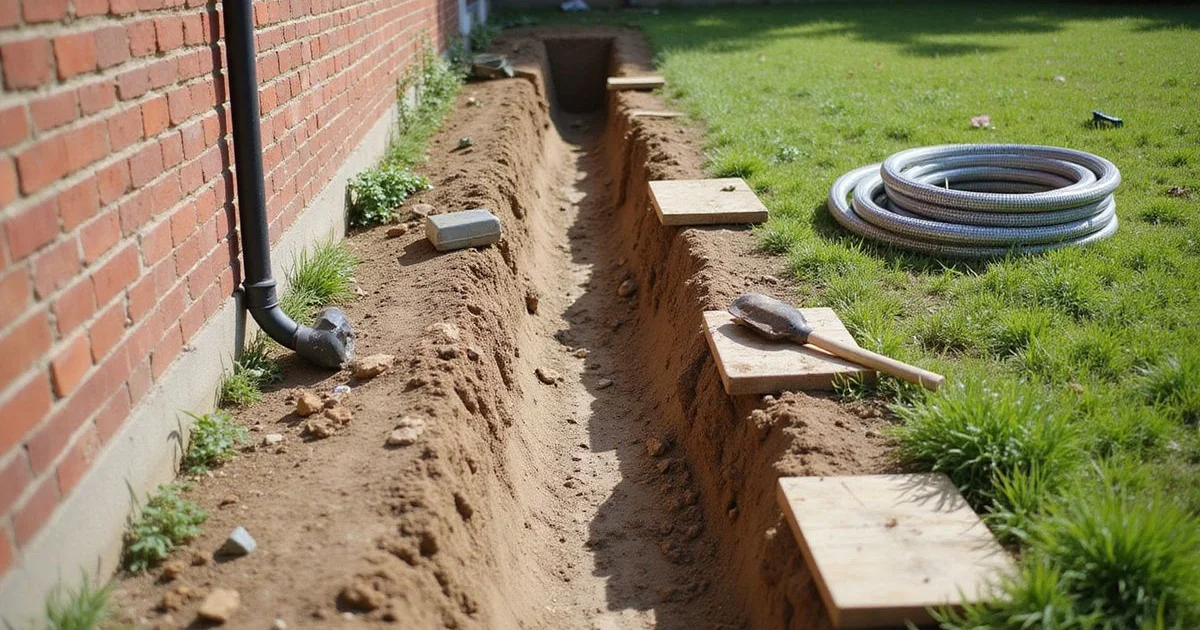
Where drainage solutions stop being enough, and where they genuinely are.
What each one actually does
Drainage work manages where water goes. Grading, downspout discharge, surface collection, subsurface drains. Its effect on a foundation is indirect: by preventing water accumulating in one area, it reduces the unevenness of soil moisture around the perimeter.
Structural repair changes what the foundation rests on. Supports driven to competent material, load transferred onto them, elevation stabilized or recovered.
The first addresses a contributing condition. The second addresses the consequence. They are not alternatives so much as different points in the same chain.
What drainage can genuinely achieve
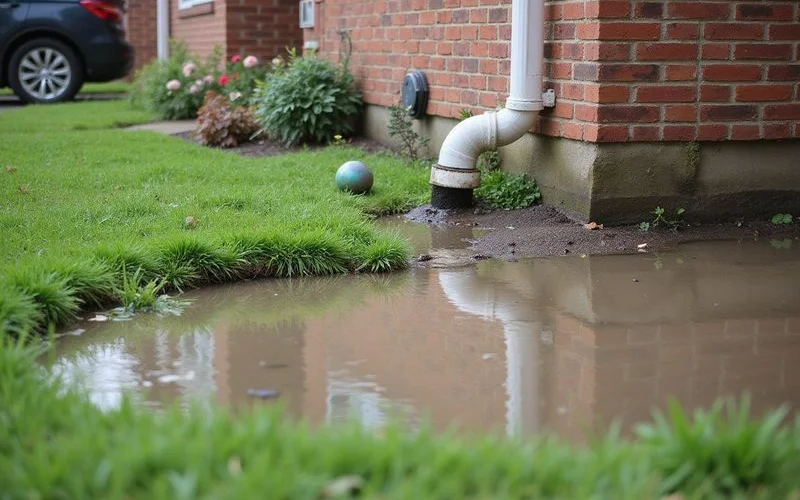
Removing a concentrated water source — a downspout emptying at the foundation, a grade falling toward the house, an irrigation leak — removes a real cause of differential soil moisture. On a property where that source is obvious and the structural movement is modest, correcting it can be the most useful single intervention.
It also protects a completed repair. Underpinning stabilize the structure; leaving a downspout pouring water against the foundation afterwards is asking the surrounding soil to keep doing what it was doing.
And it addresses problems that are not structural at all: a wet crawlspace, standing water in a yard, water reaching a garage.
What drainage cannot do
| Claim | Reality |
|---|---|
| “Fix drainage and you won’t need repair” | Not something anyone can promise |
| “It will lift the slab back” | No — drainage does not recover elevation |
| “Dry soil out and the movement reverses” | Soil re-swelling can close a surface gap without changing the structure |
| “It replaces underpinning” | It addresses a cause; it does not transfer load |
| “Standing water proves your foundation is failing” | It proves you have standing water |
That last row cuts both ways, and it is worth naming. Using a wet yard as evidence of foundation failure to sell underpinning is as dishonest as promising drainage will avoid a needed repair.
How the decision should be made
The evaluation produces two separate findings.
From the elevation survey: how much the structure has moved, where, in what pattern, and — with a repeat survey — whether it is continuing.
From the site walk: whether water is concentrating somewhere, from what source, and whether that source corresponds to where the movement is.
Cross-referencing those two gives you the answer:
- Movement modest, water source obvious and correctable → correct the drainage, monitor, re-survey at a stated interval
- Movement significant, water source obvious → structural repair plus drainage correction, often together
- Movement significant, no obvious water source → structural repair; investigate other causes including plumbing
- No meaningful movement, water source present → drainage work on its own merits, no structural scope
- Movement modest and static, no water source → monitoring
Notice that drainage-only is a real outcome, and so is monitoring-only. A provider whose recommendations always land in the structural-repair row is not reading the evidence.
Sequencing when both are needed
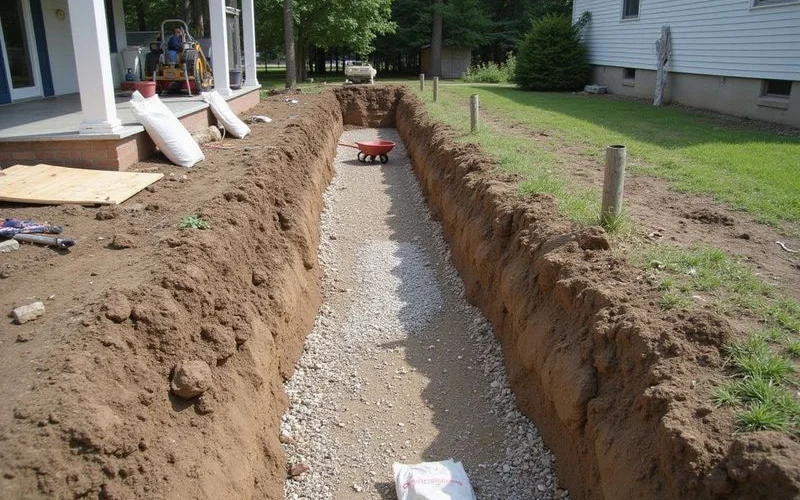
Where both are warranted, doing them together usually makes sense. Both involve excavation around the perimeter, and coordinating means one disruption to the yard instead of two, plus a single restoration.
Where drainage is being tried first as a diagnostic step, the essential element is the follow-up: a repeat elevation survey at a defined interval, compared against the original. Without that comparison you have spent money and learned nothing.
The question to ask either way
“If we do the drainage work and the movement continues, what does that tell us and what happens next?” A good answer includes a re-survey and a stated interval. A weak answer is reassurance.
Where we stand
We install drainage and we perform structural repair, so we have an interest in both. What we will not do is promise that drainage correction removes the need for a repair the evidence supports, or use a puddle as evidence that your foundation has failed.
Both of those moves are common. Neither is defensible.
For the drainage components themselves, see french drains and surface drainage and the drainage solutions service page. For structural work, see slab foundation repair.