
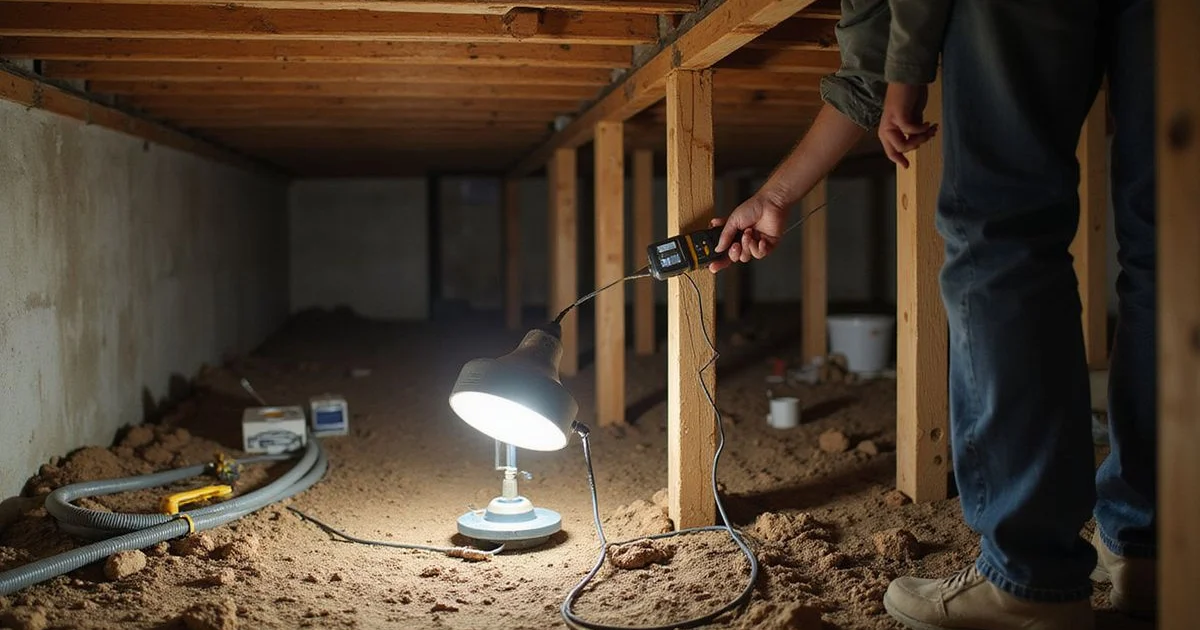
How moisture and structure relate under a crawlspace home, and why crawlspace encapsulation is quoted apart from framing repair.
The chain from moisture to structure
Crawlspace moisture does not push a floor down. What it does is create conditions in which the timber holding the floor up can deteriorate.
The sequence: moisture evaporates from bare soil into the crawlspace air, humidity rises, the moisture content of the wood rises, and where that persists, conditions favor decay. Decayed timber loses strength. A joist or girder that has lost capacity deflects under the load it used to carry comfortably, and the floor above sags.
That chain takes time and it does not run in every damp crawlspace. Understanding it matters because it explains why moisture and structure get assessed together and quoted apart.
What to observe
Standing water, or evidence of it. Water staining on piers or framing, silt lines, persistently dark ground. This is the observation that changes priorities, because bulk water needs addressing before anything else.
The ground. Bare soil, damp to the touch. An existing barrier that is torn, displaced, or only partially covering.
Odour. Musty smell in the crawlspace, or in the house above — particularly noticeable in rooms with floor vents.
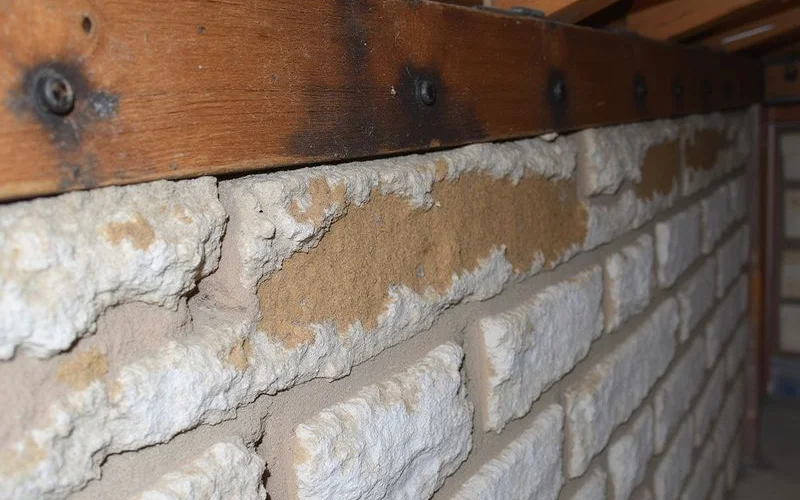
Wood condition. Darkened timber, soft or spongy areas when probed, visible fungal growth, crumbling surfaces. Concentrate on sill plates and the ends of girders where they bear on supports, because those are the wettest positions.
Insulation. Where present, whether it is damp, sagging, or has fallen away.
Ventilation. Whether existing vents are clear or blocked by landscaping and debris.

Where moisture comes from
| Source | Indicator | What addresses it |
|---|---|---|
| Ground evaporation | Uniformly damp soil, high humidity | Vapour barrier |
| Bulk water entry | Standing water, silt lines | Drainage, grading, sump |
| Surface water from outside | Water entering at the perimeter or vents | Grading and downspout management |
| Plumbing leak | Localised wet area, sometimes clean water | Plumbing repair |
| Condensation | Moisture on cool surfaces in humid weather | Ventilation strategy or dehumidification |
Identifying which one you have determines the work. A vapor barrier is the right answer to ground evaporation and the wrong answer to a plumbing leak.
Access, and being honest about it
Clearance determines how thoroughly a crawlspace can be assessed. Generous clearance means the whole structure can be reached and inspected. Low clearance means slower work and, sometimes, parts of the structure that genuinely cannot be reached.
Where that is the case, it should be stated in the evaluation rather than glossed over. “Areas beyond the central girder could not be accessed due to clearance” is a useful sentence. Silence on the point implies an inspection that did not happen.
Documenting it yourself
If you can get under the house safely, photograph: the ground condition, any standing water, the underside of the subfloor, the piers and their footings, sill plates where you can see them, and anything that looks improvised.
Note the date. Note the weather in the preceding weeks, because a crawlspace after a wet fortnight reads differently from the same space in September.
If you cannot get under safely, note that too, and note the clearance if you can see it from the access point.
Keeping the two scopes apart
This is the practical point of the guide.
Encapsulation controls moisture. Framing repair restores structural capacity. Drainage work addresses water arriving from outside.
All three may be appropriate on one house. Each should appear as its own line with its own price, so you can see what each costs, decide on each independently, and compare against another proposal.
When a quote gives a single number for the crawlspace, ask for the breakdown. The response tells you something about the proposal.
When to get it looked at
Standing water, musty odour reaching the house, soft or sagging floors above, visible soft wood, or a pre-purchase inspection. Any of those warrants someone going under with a light and a moisture meter.
That is part of a foundation evaluation on a crawlspace home, and it is the half that an evaluation done only from above would miss entirely. If encapsulation has been proposed to you as the remedy, what crawlspace encapsulation covers sets out what that scope does and does not include.