North Texas Summer 2026: Watering Your Foundation Through the Dry Season
As Fort Worth's clay soils dry and shrink through summer, consistent perimeter moisture helps. What watering can and can't do, and when to request an evaluation.
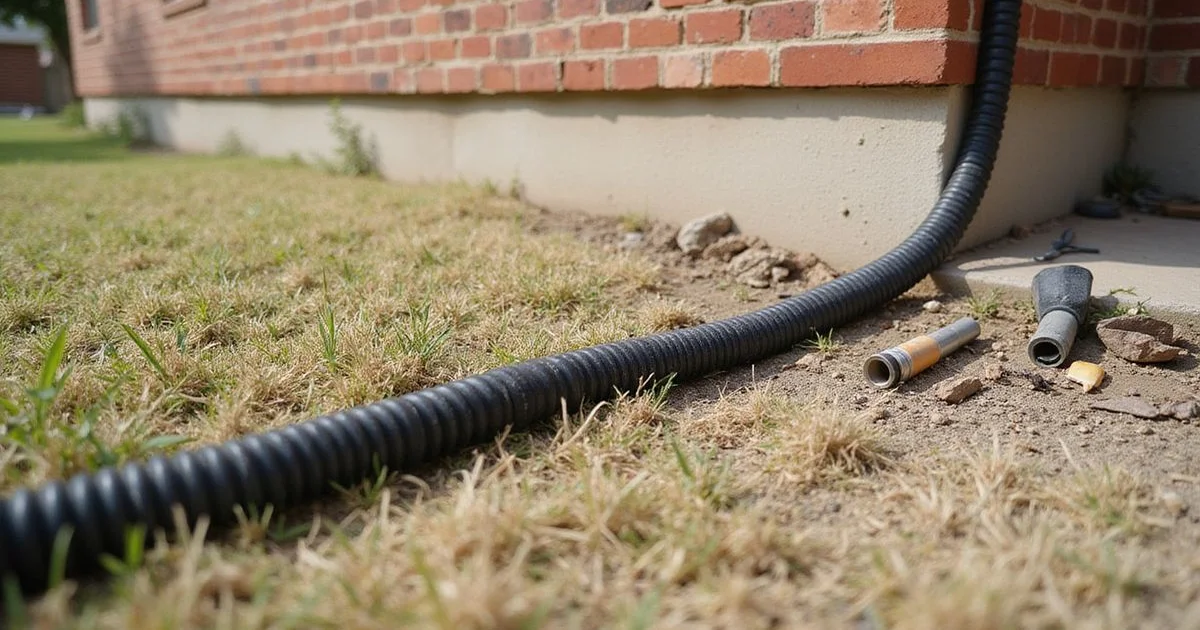
Every summer we get the same question, usually in July, usually from someone who has just noticed a gap opening between the soil and the edge of their slab: should I be watering my foundation?
The short answer is that consistent perimeter moisture through a dry North Texas summer is a reasonable maintenance habit, and it is genuinely worth doing on a lot of properties. The longer answer involves being clear about what it does, what it cannot do, and why the word “consistent” is carrying most of the weight in that sentence. It is the question we field most often in the course of doing foundation repair in Fort Worth, and the honest answer is more useful than a simple yes.
What the dry season actually does to clay
Expansive clay soils change volume with moisture content. When they take on water they swell; when they dry out they shrink. Across North Texas that cycle happens every year, and in a hot dry summer the shrinking phase is pronounced.
What you see at ground level is soil pulling back from the slab edge, sometimes with visible cracking in the surface of the yard. What that reflects underneath is soil occupying less volume than it did in spring.
The problem is not the shrinking as such. It is uneven shrinking. If soil beneath the entire perimeter of a house dried at the same rate, the whole structure would be affected equally and very little would change in the geometry of the house. What happens instead is that one side dries faster than another, usually because a mature tree is drawing moisture from that side, because sun exposure differs, or because an irrigation zone keeps one area damp while another gets nothing.
What watering is trying to achieve
The goal is not to keep the soil wet. It is to avoid the extremes — to prevent a sharp drying cycle that pulls moisture out of the ground beneath one part of the foundation much faster than the rest.
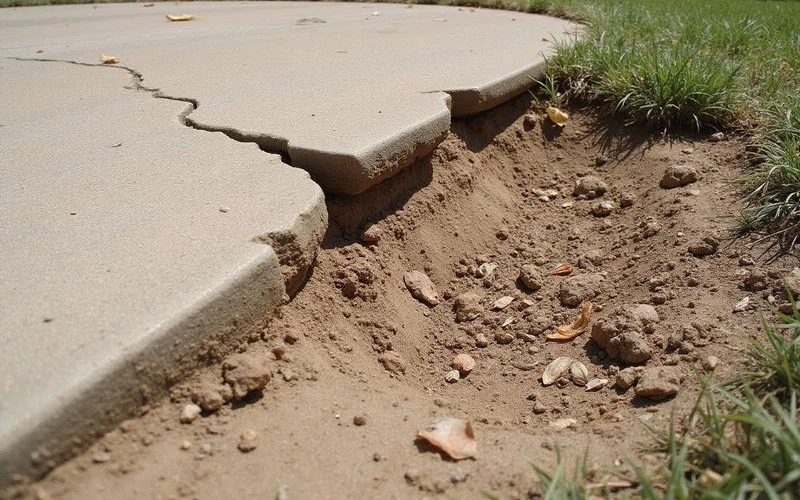
That framing matters, because it changes what good practice looks like. Even and moderate beats heavy and occasional. A soaker hose run for a modest period on a regular schedule does more good than a sprinkler blasting one corner for an hour on a Saturday.
The principle in one line
You are aiming for consistency around the whole perimeter, not saturation at the spot where you noticed the gap.
Practical guidance
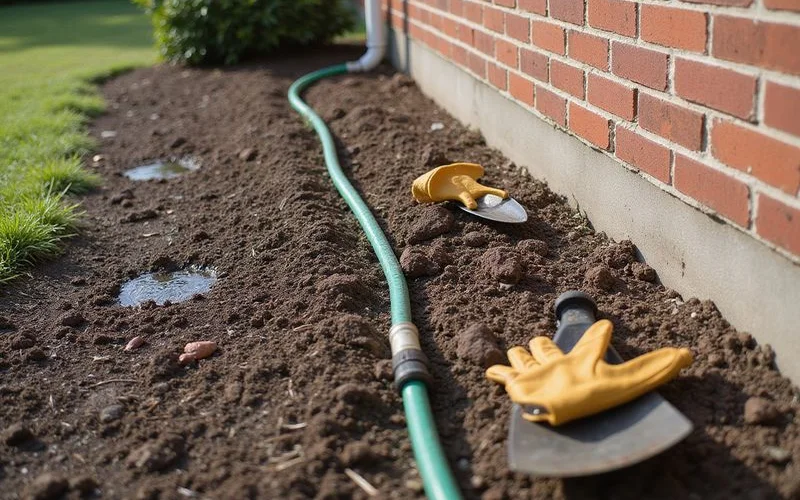
Position. Around a foot to eighteen inches out from the foundation is the usual recommendation. Right against the wall tends to run water down the face rather than into the soil, and too far out does not reach the soil that matters.
Method. Soaker hose is the standard choice because it applies water slowly and evenly. Drip works too. Sprinklers are harder to control and tend to produce uneven coverage.
Frequency. Regular and modest through the dry months. Adjust for actual conditions rather than running a fixed schedule through a wet week.
Coverage. All the way around, not just the side where you noticed something. Uneven watering creates exactly the differential you were trying to prevent.
Restrictions. Check whether your city has watering restrictions in force before setting a schedule, because these change and they vary by jurisdiction across the area.
What watering will not do
This is where we part company with some of the advice that circulates in summer.
Watering will not reverse movement that has already happened. If a section of a foundation has settled, adding moisture to the soil does not lift it back. Soil that re-swells may close a surface gap, and that can make the symptom less visible without changing the structural situation at all.
Watering will not fix a drainage problem. If roof water discharges at the foundation and keeps one area saturated while the rest of the perimeter bakes, adding a soaker hose to the dry side is treating half the issue. The downspout is the thing to fix, and where grade or roof runoff is the underlying cause, drainage solutions address it directly rather than working around it.
And watering is not a substitute for an evaluation. If doors have started sticking, if cracks are lengthening, or if something has changed noticeably this season, the useful next step is measuring the house rather than adjusting the irrigation and hoping.
| What you are seeing | Watering helps | What actually addresses it |
|---|---|---|
| Soil gap at the slab edge, nothing else changed | Yes — reduces the extremes | Consistent perimeter moisture, monitor |
| Downspout pouring next to the foundation | No | Extend or bury the discharge |
| Doors sticking that were fine in spring | Not on its own | Evaluation with elevation readings |
| Crack that has lengthened this summer | No | Evaluation, document the change |
When to stop watering and call someone
If more than one observation has changed this season, if they line up on the same side of the house, or if something has stopped functioning — a door that will not latch, a window that will not close — that is a measurement question rather than a moisture question.
The foundation evaluation is what settles it: elevation readings across the house, plus documented observations, plus an honest interpretation of what they indicate. Sometimes that produces a recommendation to monitor and keep watering. Sometimes it does not.
Either way, you get the answer from evidence rather than from a hose.
Noticed something change this summer? — Request a foundation repair quote